
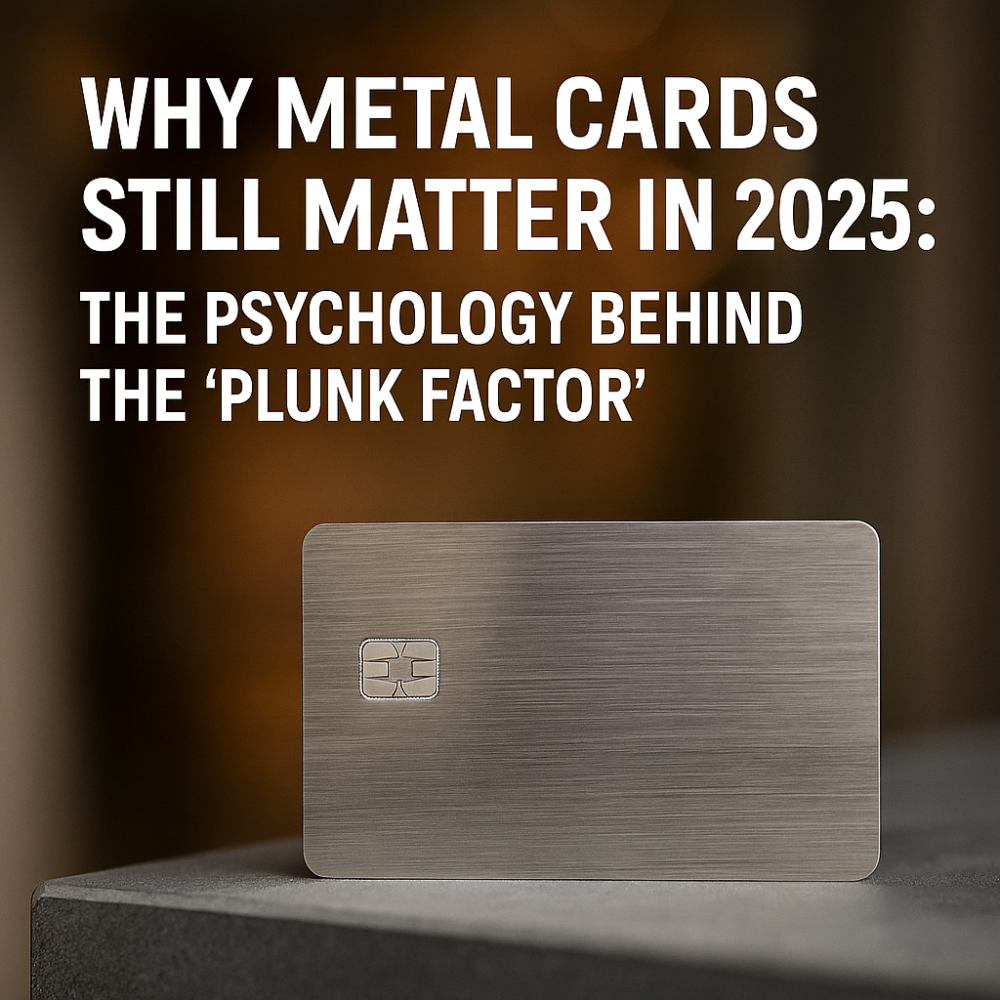
Why metal cards still matter (and why they’re not going away)
If you caught our last article on loud budgeting and metal debit cards, you already know the new flex isn’t debt, it’s discipline with style. If you missed it, start there: Loud Budgeting, Quiet Flex: How a Custom Metal Debit Card Lets You Show Off and Stay Out of Debt.
This time, let’s zoom in on a different question:
With mobile wallets, tap-to-pay, and virtual everything… why do people still care so much about metal cards?
Short answer:
Because money isn’t just numbers. It’s psychology.
There’s a reason card issuers obsess over the sound and weight of their metal cards. That satisfying “plunk” when a metal card hits the counter has literally become a marketing feature and a status signal—especially among millennials and younger professionals who care about design, travel, and dining out.
And consumers are responding:
-
A global survey found 68% of cardholders prefer a bank that offers a metal payment card when rewards are equal.
-
The metal card market is projected to more than double in the next decade, driven by demand for premium-feeling cards that stand out.
So no, metal cards are not a fad. If anything, they’re becoming the physical anchor in an increasingly digital payments world.
The “plunk factor” explained: more than just a cool noise
The term “plunk factor” came out of card marketing and media coverage back when metal cards started appearing in the 2000s and 2010s. Card issuers realized something simple:
-
A heavier card with a distinct sound when it hits the table
-
Makes the experience of paying feel more memorable and premium
Mastercard has even pointed to that “prestigious plunk factor” as part of the story of metal card evolution—from stainless steel to titanium and beyond.
Recent coverage still frames it the same way:
-
Articles on metal cards talk about how that clank on the counter became shorthand for “high-roller.”
-
Market research notes that millennials see metal cards as a way to express individuality and status, not just a way to pay.
But here’s the important thing: it’s not just noise.
The plunk factor is a perfect example of how sensory details change how we feel about money:
-
Heavier = feels more substantial and important
-
Cool metal = feels more premium and deliberate than flimsy plastic
-
Distinct sound = makes the moment of paying feel like a statement instead of a quick tap-and-forget
Psychologically, that small moment reinforces:
“I’m the kind of person who carries serious, intentional tools—not throwaway plastic.”
Why metal cards work in a digital-first world
You’d think that with Apple Pay, Google Pay, and one-click checkouts everywhere, the physical card would matter less.
Reality check: consumers still care a lot about how the card looks and feels.
Recent industry surveys show:
-
Cardholders place growing importance on card design and material as part of their overall banking experience.
-
Metal cards are seen as more secure, durable and prestigious, which builds emotional loyalty to the issuer.
In other words:
-
Your phone might handle tap-to-pay,
-
But your card still represents your relationship with money and your bank in the physical world.
A PaymentsJournal analysis put it bluntly: metal cards “engage the senses,” making payments more emotional and memorable, and that sensory experience keeps customers more loyal to the bank that gave it to them.
That’s why banks are investing heavily in metal card programs even as the luxury goods market is cooling and aspirational buyers are more cautious.
The card has become:
-
A mini luxury item you carry daily,
-
Less about flexing unlimited spending and more about feeling aligned with your self-image.
Status has shifted: from “I can spend anything” to “I’m intentional”
We’re entering a weird-but-interesting era:
-
Luxury brands are getting pushback for aggressive pricing on handbags and watches. Aspirational buyers are more selective and value-conscious.
-
At the same time, people still want items that feel premium, unique and “them.”
So the definition of status is changing:
-
Old status: “I can buy anything.”
-
New status: “I make smart moves but still live well.”
That’s why:
-
A $7,000 handbag might feel like a bad call right now.
-
But a one-time upgrade that transforms the card you use every day into a premium metal card feels like a better value equation.
You’re not buying another logo to sit in a closet:
You’re upgrading a tool you already use daily—your payment card—so it finally matches the standard you hold for yourself.
Why banks love metal cards (and why that matters to you)
Banks and fintechs didn’t double down on metal cards just for the aesthetics. They did it because:
-
Metal cards attract new customers,
-
Make people use that card more,
-
And increase loyalty and retention in a crowded market.
Surveys show:
-
A majority of bank customers would prefer a metal card if rewards were equal.
-
Many are even willing to switch banks or pay extra fees to get one.
You don’t have to love the bank marketing game to understand the signal:
Metal cards work. They change how people feel about their wallet, their account, and themselves.
That’s exactly why Metal-CreditCard.com exists:
-
Instead of waiting for your bank to eventually offer a metal card with the “right” rewards combo,
-
You can upgrade the card you already use into a custom metal card that hits the same emotional notes.
How a custom metal card from MCC fits into this psychology
Let’s bring it home.
Everything we just talked about—plunk factor, sensory experience, status, loyalty—gets sharper when the card is custom to you.
With Metal-CreditCard.com:
-
You keep your existing bank and account
-
We’re not a bank and we don’t issue cards.
-
We upgrade the physical body of your current debit or credit card into a premium metal form factor.
-
-
You control the design
-
Minimalist and blacked-out?
-
Sharp logo and typography for your business?
-
A subtle symbol of your values or background?
Whatever you choose, the psychology is the same:
This card looks and feels like mine, not like something mass-printed for everyone.
-
-
You elevate the plunk factor without another credit line
-
No need to apply for the latest invite-only product just to get a heavy card.
-
You can even apply this to a debit card (especially powerful if you’re on that loud budgeting path from last weeks article).
-
-
You create a piece you’re proud to hand over
-
At restaurants, hotels, car rentals, client lunches—moments where first impressions matter.
-
That metal card becomes a small but real part of your personal brand.
-
Where to go from here (and how to stay in the series)
If you missed the first article in this series, go back and read:
👉 Loud Budgeting, Quiet Flex: How a Custom Metal Debit Card Lets You Show Off and Stay Out of Debt
That piece covers:
-
How loud budgeting is changing money culture
-
Why metal debit cards make so much sense right now
-
How to flex without taking on extra credit
Then, when you’re ready to turn the psychology you just read about into something real in your wallet:
👉 Head over to our Order Today page and start designing your own custom metal credit or debit card.
The world is getting more digital.
Your card doesn’t have to disappear into that.
Make it count—and make it metal.